What’s banana chips?
Banana chips are made from fresh bananas which go through the process of washing, peeling, slicing, frying, de-oiling and packaging. The bananas are thermally processed to reduce their moisture content to varying degrees of crispness, with the resultant product retaining the banana’s characteristic sweet flavour.
What is the process of making banana chips?
Fresh bananas→Raw material selection→Washing→Peeling→Slicing→Pre-treatment→Frying→De-oiling→Cooling→Seasoning (optional)→Packaging.
The exact process can be tailored to the raw banana material, the requirements of the end product and the capacity of the plant.
1. Banana Washing
The surface of the bananas can be quite dirty with soil, dust and all sorts of other stuff on them so a wash is required prior to peeling. In the industrial situation the correct washing equipment (water jets, spraying, mechanical washing etc) can be selected depending on the state of the raw material to remove the surface contaminants.
2. Peeling and Slicing
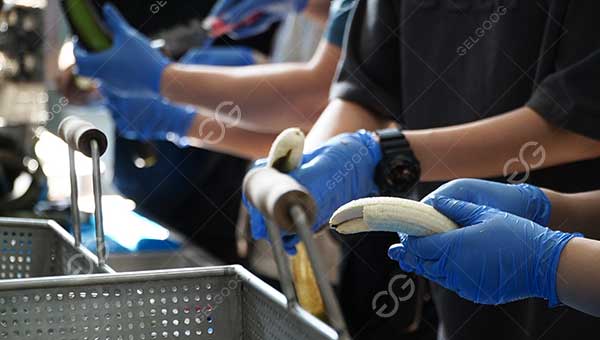
Peeling can be done manually or (on a larger scale of production) by the use of dedicated auxiliary equipment.
Slicing is a very important step as it will have a direct bearing on both the finished appearance and the texture of the chips. If the slices are too thick the internal moisture won’t get drawn out sufficiently and you’ll end up with a product that’s too hard. If the slices are too thin they’re very prone to breaking and also much more likely to go black during the frying.
3. Pre-treatment
Whether or not pre-treatment is required after slicing will depend on the ripeness of the bananas, the particular recipe and the desired end product. In some processes a colour retention treatment is used to minimise the colour change that occurs in the slices during the time they are in the process.
4. Frying
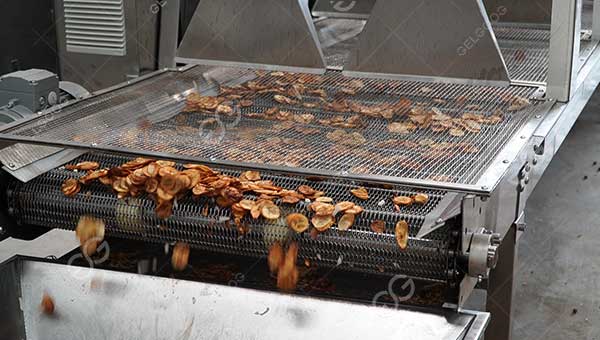
Frying is the key step in determining the flavour, colour and texture of the banana chips. As the slices go into the fryer the moisture is driven off under controlled temperature and time conditions and this is what gradually builds up the crispness.
5. Oil Removal and Cooling
After frying the chips the excess oil must be removed from the surface of the banana chips. Correct oil removal will help to reduce the greasiness and will prevent the residual surface oil from having a detrimental effect on the packaging materials during the packaging process.
6. Seasoning and Packaging
Banana chips can be seasoned post-frying depending on the product positioning. For example they could be seasoned with the requisite amount of sugar powder or other seasonings as per the recipe. It’s important that the seasoning is even and that you don’t overdo it as this would have a negative impact on the product’s appearance.
Packaging is the final stage of the process. The packaging specification you select will be very much dictated by your sales channel and you should be using packaging materials which have excellent moisture barrier properties.
Key Considerations in the Banana Chips Making Process:
- Control the ripeness of the raw material
- Ensure uniform slice thickness
- Manage your frying conditions properly
- Keep strict hygiene and quality checks
Choose production equipment that meets capacity needs.As one business is going to differ from another in terms of raw material supply, facility size, labour costs and market demand there is no single ‘off the shelf’ configuration of a banana chips production line. Please get in touch with us to discuss the equipment that is right for your particular application.