Bananas are highly versatile fruits; beyond being consumed fresh, they can undergo industrial processing to create a variety of products such as banana chips, banana powder, banana puree, and dried bananas. what are the steps involved in processing bananas? Since different products have varying requirements regarding the state of the raw material, moisture content, texture, color, and preservation method, the specific processes employed in actual production vary accordingly.
For example, the production of banana chips focuses on slice thickness, the degree of dehydration, and the crispness of the final product; banana powder, on the other hand, requires further moisture reduction and the use of grinding and sieving processes to obtain a uniform powder. Consequently, banana processing lines are typically designed with equipment configurations tailored to the specific final product. The following are some common steps involved.
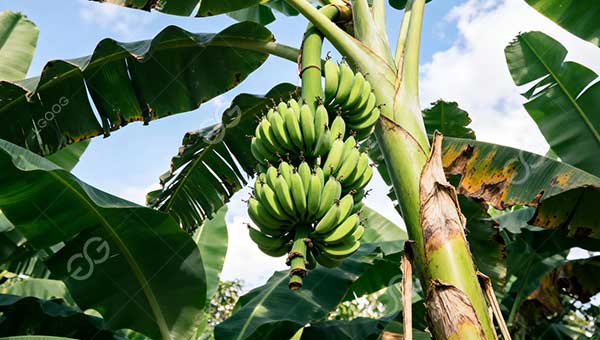
1. Washing
Banana surfaces may be contaminated with soil, dust, and other impurities; proceeding directly to subsequent processing stages could compromise product hygiene and equipment cleanliness.
Industrial production typically employs methods such as spray washing, bubble washing, or brush washing, with the specific equipment selected based on the level of surface contamination.
The primary purpose is to reduce surface contamination on the raw material and create cleaner production conditions for subsequent processing steps.
2. Peeling
After washing, the bananas must be peeled. Banana peels are generally not part of the main products—such as banana chips or banana flour—and therefore need to be separated prior to processing. Depending on production volume and product specifications, peeling can be performed manually or by using specialized banana-peeling equipment. Manual peeling remains common for small- to medium-sized production lines, whereas large-scale factories prioritize peeling efficiency and the reduction of labor costs.
3. Cutting into segments or slices
Once peeled, the bananas can be processed in various ways depending on the final product. For banana chips, the bananas must be cut into slices of uniform thickness or other shapes; for banana flour or pulp, they may first need to be cut into segments or broken down to facilitate feeding into downstream processing equipment.
The primary purpose of this step is to control the size of the raw material and improve the efficiency of subsequent drying, frying, or pulping operations.
4. Color Preservation and Pre-treatment
Banana pulp is prone to browning when exposed to air; therefore, certain processed banana products require color preservation or pre-treatment.
In industrial production, methods such as antioxidant treatment or brief heat treatment can be employed—depending on product formulations and processing requirements—to mitigate browning reactions. This step is particularly important for products like banana chips, dried banana slices, or banana powder, where maintaining good color is essential.
5. Frying
If producing fried banana chips, the product typically undergoes the frying stage after slicing and pre-treatment.
During frying, the moisture content of the banana chips rapidly decreases, while a distinctive aroma, color, and texture are developed. Depending on the product positioning, either traditional atmospheric frying or vacuum frying may be employed.
6. De-oiling
Fried banana chips typically retain a certain amount of oil on their surface, necessitating a de-oiling process. In industrial production, centrifugal force is used to rapidly remove excess surface oil, resulting in a drier finished product and minimizing the impact of residual oil on packaging materials during subsequent packaging.
7. Drying
Drying is a crucial processing step when producing low-moisture products such as dried banana slices or banana powder. After being sliced, cut into segments, or crushed, the bananas are fed into hot-air drying equipment, where moisture is gradually removed by controlling temperature, airflow velocity, and drying time. For banana powder, the raw material typically requires thorough drying first to reach a moisture level suitable for pulverization.Of course, banana processing is not a fixed production workflow; the equipment must be selected based on the final product. If you are unsure about the specific equipment you need, please feel free to contact us.